
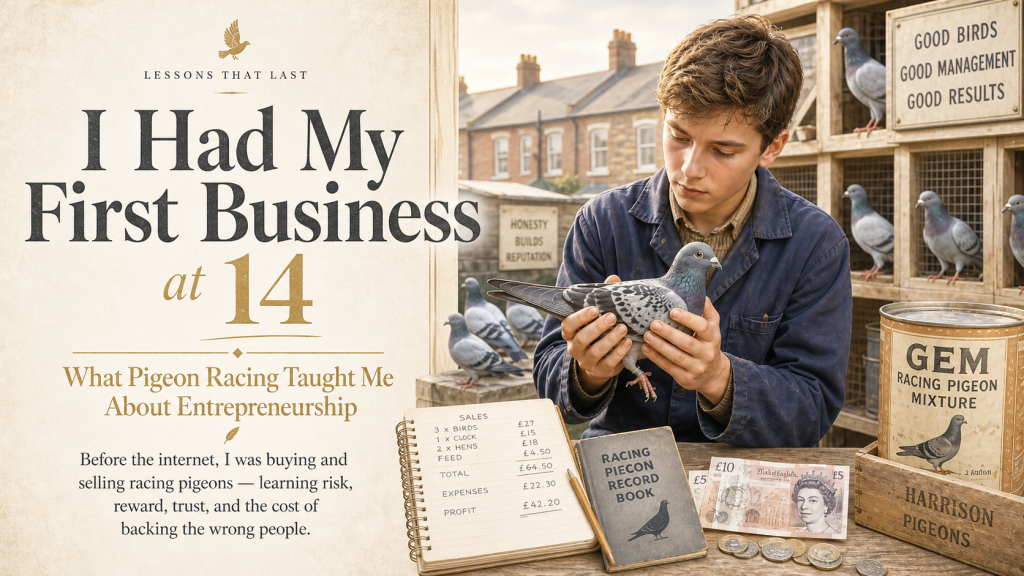
Before the internet, before the adult industry, before all of it — I was a 14-year-old buying and selling racing pigeons, learning risk, reward, and the cost of trusting the wrong people.
Before the internet.
Before the adult industry.
Before the Bahamas, the money, the collapse, the bankruptcy, the prison sentence, the comeback attempts, the software products, the memberships, the media plans, and all the other chapters that came later.
There were pigeons.
Racing pigeons.
That is where business really started for me.
Not in a boardroom.
Not in a classroom.
Not from some polished business book written by someone who has never had to graft for a living.
It started with me as a 14-year-old, buying and selling racing pigeons, trying to understand value, risk, trust, instinct, bloodlines, performance, reputation, and how money moved between people.
Looking back, I can see it now.
Pigeon racing was my first business school.
And it taught me more about entrepreneurship than most people would ever expect.
I did not know I was learning business
At 14, I was not sitting there thinking, This is my early entrepreneurial education.
I just loved pigeons.
I loved the sport.
I loved the birds.
I loved the breeding.
I loved the racing.
I loved the characters.
I loved the possibility that the right pigeon, from the right family, with the right conditioning, could go out and do something special.
But underneath that passion, something else was happening.
I was learning how markets work.
Because pigeon racing is not just a hobby. Not really. It is a world with value, emotion, competition, reputation, speculation, loyalty, obsession, ego, hope, and money all mixed together.
In other words, not that different from business.
People buy on belief.
People pay for proof.
People chase winners.
People trust names.
People get caught up in stories.
People overpay when emotion takes over.
People underestimate things that do not look flashy enough.
People follow reputation, sometimes wisely and sometimes blindly.
That is a market.
I did not have those words for it then.
But I was learning it.
Pigeons taught me value is not always obvious
One of the first lessons pigeon racing teaches you is that value is not always sitting there in plain sight.
A pigeon can look ordinary and be bred from gold.
Another can look impressive and be worth very little as a racer or breeder.
A flashy name does not always equal performance.
A quiet bird in the corner can sometimes carry the thing everyone else is looking for.
That lesson has stayed with me in business.
Because people often misjudge value.
They get distracted by surface.
The big website.
The polished pitch.
The loud personality.
The shiny branding.
The confidence.
The story.
Sometimes those things matter.
But real value is usually deeper.
It is in the bloodline, so to speak.
The structure.
The track record.
The repeatability.
The hidden advantage.
The work behind the scenes.
The ability to perform when conditions are difficult.
In pigeons, you learn not to judge too quickly.
In business, the same rule applies.
Risk and reward become real when it is your own money
There is a big difference between talking about risk and feeling it.
At 14, when you are buying and selling pigeons with your own money, even small amounts feel significant.
You learn the feeling of putting money into something because you believe you can sell it, improve it, breed from it, race it, or turn it into something better.
You also learn the feeling of being wrong.
That is important.
Because entrepreneurship is not just confidence.
It is judgement under uncertainty.
You make decisions without guarantees.
You assess imperfect information.
You trust your instinct.
You listen to advice.
You weigh the story against the evidence.
You take a punt.
You sometimes get rewarded.
You sometimes get stung.
That is business.
And pigeon racing taught me that early.
The sport taught me about reputation before I knew the word properly
In pigeon racing, reputation matters.
The reputation of the fancier.
The reputation of the bloodline.
The reputation of the loft.
The reputation of a seller.
The reputation of a bird’s results.
You learn quickly who people trust, who they doubt, who talks a good game, who quietly delivers, and who has a habit of overpromising.
That is business education at ground level.
Because reputation is one of the oldest currencies there is.
Before Google reviews, social proof widgets, Trustpilot, testimonials, screenshots, and personal branding, there was simple word of mouth.
Who is straight?
Who knows their birds?
Who sells rubbish?
Who pays properly?
Who exaggerates?
Who can be trusted?
At 14, I was already absorbing that.
And I learned something that still matters today:
A good reputation can open doors.
A bad reputation follows you around like a bad smell.
I also learned the cost of trusting the wrong people
This is one of the harder parts.
Because any world with money, ambition, competition and emotion will attract good people and bad people.
Pigeon racing is no different.
There are brilliant people in the sport. Proper characters. Generous people. Knowledgeable people. Men and women who will help a youngster, pass on advice, gift a bird, share knowledge, and give you a leg up.
But there are also people who will take advantage.
Especially if you are young.
They will oversell.
They will exaggerate.
They will spot your enthusiasm and use it.
They will tell you what you want to hear.
They will make poor stock sound like treasure.
They will trade on your lack of experience.
That was a painful lesson.
But it was a useful one.
Because business is exactly the same.
Not everyone smiling at you is on your side.
Not everyone with confidence has substance.
Not everyone with a story has proof.
Not everyone who calls themselves experienced is honest.
Not everyone who gives advice is doing it for your benefit.
You learn that the hard way.
And once you do, you are never quite as naive again.
Passion is powerful, but it can make you vulnerable
This is something pigeon racing taught me very early.
When you love something, you can be easier to sell to.
That is true whether it is pigeons, cars, crypto, software, property, collectibles, sport, or business opportunities.
Passion makes you lean in.
It makes you dream.
It makes you see potential.
It makes you imagine what could happen if this bird, this deal, this product, this opportunity, this partnership turns out to be the one.
That passion is not bad.
Without passion, most worthwhile things never get built.
But passion without judgement is dangerous.
At 14, I was passionate about racing pigeons. That passion gave me drive. It made me learn. It made me study bloodlines, results, lofts, breeding, racing performance and the people in the sport.
But it also made me vulnerable to being too eager.
That is a lesson many entrepreneurs need.
Love the game.
But do not let your love of the game switch your judgement off.
Pigeon racing taught me about delayed gratification
Business people love talking about overnight success.
Pigeon racing does not really work like that.
You can buy a bird today, but the proof might take years.
You have to breed.
You have to rear.
You have to train.
You have to race.
You have to observe.
You have to learn from losses.
You have to decide what to keep, what to move on, what to pair, what to test again.
It is a long game.
And the long game teaches patience.
That is something a lot of modern entrepreneurs lack.
They want instant results.
Instant sales.
Instant attention.
Instant traction.
Instant proof.
But anything meaningful usually takes time.
You need seasons.
In pigeons, you learn that one result does not make a dynasty.
One good race does not prove a line forever.
One bad day does not necessarily mean everything is worthless.
You have to look at patterns.
Business is the same.
The best pigeons perform when conditions are hard
That might be one of the biggest lessons of all.
In pigeon racing, the real test is not always when everything is easy.
It is when the conditions are hard.
Bad weather.
Distance.
Headwinds.
Difficult routes.
Unpredictable days.
The kind of race where only the best-conditioned, best-bred, most determined birds find their way home properly.
That tells you something.
Because business is the same.
Plenty of people look good when conditions are easy.
Easy market.
Easy money.
Easy traffic.
Easy timing.
Easy attention.
Easy sales.
But when things get hard, you see what is really there.
You see who has substance.
You see who has resilience.
You see who understands the fundamentals.
You see who was built for it and who was just enjoying favourable conditions.
I have always respected pigeons that come through hard races.
And I respect people and businesses the same way.
Selection matters
In pigeons, you cannot keep everything.
You have to select.
That is a brutal but necessary part of the sport.
You select based on performance, breeding, health, temperament, instinct, results, potential and your own judgement.
If you keep everything, you weaken the loft.
That lesson applies to business more than people realise.
You cannot keep every idea.
You cannot pursue every opportunity.
You cannot build every product.
You cannot say yes to every partnership.
You cannot carry weak projects forever just because you once believed in them.
Selection matters.
Sometimes the strongest thing you can do is remove what is not performing so the better things have room to grow.
That is a hard lesson.
But it is one every serious entrepreneur eventually has to learn.
It gave me the trading instinct
Buying and selling pigeons taught me something very practical.
How to trade.
How to spot value.
How to negotiate.
How to judge demand.
How to read people.
How to understand what a buyer cares about.
How to present something properly.
How to take a profit.
How to move stock.
How to reinvest.
That trading instinct has stayed with me my whole life.
Whether I was building websites, creating products, launching software, selling memberships, building PLR offers, working on pigeon syndicates, or developing new business ideas, that same instinct has always been there.
Find value.
Package it.
Create demand.
Sell it.
Reinvest.
Improve.
Repeat.
It started with pigeons.
That might sound strange to some people.
But to me, it makes perfect sense.
The sport stayed with me because it is more than business
The funny thing is, pigeon racing was never just a commercial thing for me.
It still is not.
I love the sport.
I have been involved in it for over 35 years now. I still care about the birds, the breeding, the history, the families, the one loft races, the long-distance performances, the characters, the stories, and the strange magic of a pigeon finding its way home from hundreds of miles away.
There is something in that sport that gets into you.
And maybe that is why the business lessons stuck so deeply.
Because they were attached to something I actually cared about.
That matters.
The best education often comes from the things you are obsessed with before anyone tells you they are “useful”.
Final thought
My first business was not online.
It was not glamorous.
It was not backed by investors.
It did not have a brand deck.
It did not have an email funnel.
It did not have a software dashboard.
It was me at 14, buying and selling racing pigeons.
Learning value.
Learning risk.
Learning trust.
Learning reputation.
Learning selection.
Learning patience.
Learning how exciting business can feel when you spot an opportunity and act on it.
It also taught me the cost of trusting the wrong people.
And that was part of the education too.
Because entrepreneurship is not just about making money.
It is about judgement.
Who to trust.
What to buy.
What to sell.
What to keep.
What to cut.
When to wait.
When to act.
When to walk away.
I did not learn those lessons in a classroom.
I learned many of them in a pigeon loft.
And in all honesty, that was probably the perfect place for me to start.
Keep going, keep building 🙂
Mark Lyford